How to Price Your Pet Grooming Services Fairly
Stop copying competitors' prices. A practical framework for pricing grooming services that covers real costs, breed complexity and your time.
Ask ten groomers how they set their prices and nine of them will tell you a version of the same story: "I looked at what the salon down the road charges, and I went a bit under." It's understandable; pricing feels awkward, and competitors give you something to point at. But it's also how entire regions of groomers end up earning less than the cost of their product, with no idea where the money is going.
Pricing well isn't about being cheap or being expensive. It's about charging a number that covers your costs, pays you a real wage, and scales with the actual work involved. Breeds are different. Coats are different. A 45-minute bath on a Yorkie isn't the same job as a 2-hour full groom on a doodle. Your price list should reflect that.
Start with what it actually costs you
Most groomers systematically under-count their costs. A price list that ignores real costs is a price list that gets slowly strangled by inflation and a second-hand van that needs new tyres.
- Products. Shampoo, conditioner, cologne, detangle spray, ear cleaner, clipper oil. Calculate per-dog, not per-bottle.
- Tools and wear. Clippers, blades, scissors, dryers, tables. Blades dull, dryers die, tables wear. Budget for replacement, not just repair.
- Overhead. Rent, electricity, water, heating, insurance, software, internet, accountant. Divide by the number of dogs you realistically groom in a year.
- Your time. This is the one groomers forget. If your target is €25/hour take-home, and a small full groom takes 90 minutes, the labour line alone is €37.50, before anything else.
- Tax. In NL, that's 21% VAT on top (sometimes), plus income tax and social contributions on the way out. Your sticker price needs to survive both.
Add those together per dog and you have the floor. Any price below the floor is a loss. You do not discount below your floor; you cancel.
Then add real grooming variables
Once your baseline is in place, pricing by breed and coat isn't optional; it's how you stop bleeding time.
- Breed complexity. A Bichon is not a Jack Russell. Structure coat, trim-and-scissor work, and the time to pattern it all are bigger.
- Coat condition on arrival. A well-brushed dog arrives ready to groom. A matted dog arrives with a project attached. Charge for the project.
- Size and weight. Bathing, drying, and handling a 40 kg dog takes longer than a 6 kg one. Not double, but it's not the same either.
- Behavioural difficulty. A nervous or aggressive dog needs a slower pace. Build a surcharge into your price list for the dogs that genuinely need it. You're not punishing them; you're paying yourself for the extra time.
- Extras that quietly take time. De-shedding, teeth brushing, nail grinding, anal glands, sanitary trims. These belong as line items on the invoice, not as a vague "plus whatever".
Build a real price list, not a range
"€40 to €80" is not a price list. It's a negotiation starter. And negotiation is where groomers lose money, apologetically.
A good list is:
- Written down: visible on your website and your wall.
- Broken out by breed: or at least by breed group (small, medium, large, doodle-type, hand-stripped).
- Additive, not all-in: base groom price, plus de-matting if needed, plus teeth, plus nail grind. Clients understand what they're paying for.
- Updated annually: not every month, not every five years. Once a year, you look at your costs and adjust. Put it in your calendar.
Make rebooking the default
A fair price is much easier to hold if your clients come back often enough that dogs stay in good condition. A Goldendoodle on an 8-week cycle is a reasonable job. The same dog left for 14 weeks is a matted emergency. Your pricing (and your rebooking cadence) should encourage the first and avoid the second.
- Offer a rebooking window at the end of each appointment. Clients who leave with a slot already booked come back at the right interval.
- Price for the right interval. A de-matting surcharge is a pricing signal: "if you bring the dog back on time, you save this much."
- Track which clients slip so you can follow up before the dog turns into a project.
Where software helps
Pricing is mostly a pen-and-paper exercise. Where software helps is keeping the list consistent across staff, making sure every invoice reflects it, and showing you which services actually earn you money, and which just take up the afternoon.
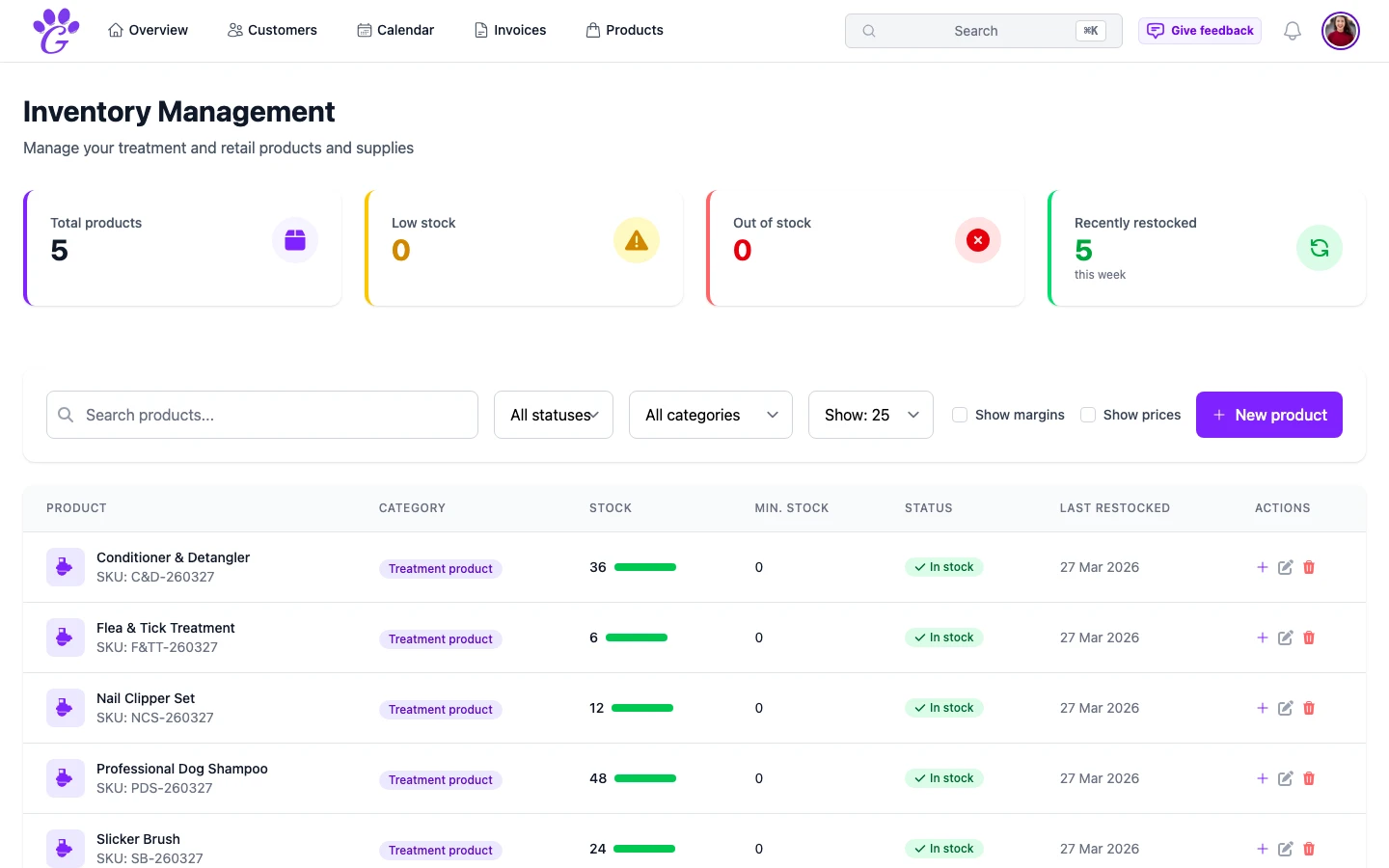
GroomSome's breed-specific pricing keeps a price per breed, so the suggested price on every appointment reflects the dog that's actually booked. Its revenue analytics show you, monthly, which services pulled in the most revenue and which barely paid for the shampoo. A year of that data makes your next annual pricing review a five-minute job.
Pricing isn't a one-off
The biggest mistake in grooming pricing isn't charging too much or too little; it's setting a list in 2019 and never looking at it again. Costs rise. Blades get expensive. Rent goes up. Your time is worth more every year you've been grooming. A list that doesn't keep up with reality is a list that quietly eats your income.
Pricing fairly is not about asking for more; it's about asking for what the work actually is. Once your list reflects real costs, real coats, and real dogs, the uncomfortable conversations mostly stop. The price is the price, in writing, and it makes sense.