How Much Can You Earn as a Pet Groomer?
A realistic look at pet groomer income. Solo groomers vs salon owners, hourly vs per-dog pricing, regional differences in NL, DE and the UK.
"How much can I actually earn as a groomer?" is one of those questions that everyone asks quietly and nobody answers honestly. Public figures usually come from job boards (which underestimate the self-employed) or from one or two influencers sharing their best years. Neither reflects what a normal grooming business really brings in.
The answer is more useful when it's broken down by the shape of the business. Solo groomers earn one thing; salon owners earn another. Mobile, home salon, and shop are different. NL, DE, and the UK have different cost structures. The short version: grooming can be a good living, but only if you price properly and track the numbers, and most groomers don't.
The two incomes: revenue and take-home
The biggest cause of confusion. A groomer making "€6,000 a month" is not taking home €6,000. Once you strip out products, rent, equipment wear, insurance, accountant, software, and fuel, the real take-home is often half of the revenue number. And then there's tax on top.
- Revenue = what clients pay you.
- Gross profit = revenue minus variable costs (shampoo, consumables, per-dog stuff).
- Net profit before tax = gross profit minus fixed costs (rent, insurance, software, depreciation).
- Take-home = net profit minus income tax and social contributions.
Most conversations mix these up. Always ask "before or after tax and costs" when someone quotes a number.
Solo groomer, full-time
A full-time solo groomer doing around 5–7 dogs a day, five days a week, is typical. At an average ticket of €55 per dog (Netherlands) and six dogs a day, that's €330 a day, €1,650 a week, roughly €6,500 a month gross.
Typical cost structure (solo salon in a small town):
- Rent + utilities: ~€800
- Products and consumables: ~€600
- Insurance, accountant, software, phone: ~€250
- Equipment wear/replacement: ~€150 (amortised)
Net before tax: ~€4,700 Take-home after income tax and social contributions (NL): ~€3,000–€3,500 a month.
That's a real, honest number for a busy solo groomer. Not glamorous, but perfectly liveable. Prices and costs vary by region.
Mobile groomer
Mobile is a different cost shape. Fewer dogs per day (typically 4–5), higher ticket per dog (€70–€100), but significant vehicle costs and travel time.
- Revenue: €5,000–€7,000 per month gross at capacity.
- Van + fuel + maintenance: often €600–€900/month.
- Products, water, generator: similar to shop.
- No rent, but insurance and vehicle depreciation offset that.
Take-home for a busy mobile groomer in NL/DE is often slightly below a busy solo shop, but with more flexibility and no lease commitment.
Salon owner with one or two groomers
This is where the income profile changes significantly. A two-groomer salon doing twelve dogs a day, five days a week, at an average ticket of €55:
- Revenue: ~€13,000/month gross.
- Employee cost (one full-time groomer + taxes/social): ~€3,500.
- Rent, utilities, products, fixed costs: ~€2,500.
- Equipment + software + insurance: ~€500.
Net before tax for the owner: ~€6,500. Take-home for the owner: ~€4,000–€4,500/month.
Owning a salon is not automatically more profitable than being solo; the extra revenue pays for the extra staff. What you get is leverage (more revenue for the same hours), not a higher hourly rate. The real financial uplift comes at three or more groomers.
Hourly vs per-dog pricing
Most groomers price per dog. A few price by the hour. Both are valid.
- Per-dog pricing works when your breed-based price list is accurate. A Yorkie bath has a price, a Doodle full groom has a different price. Simple.
- Hourly pricing works for complex, long, or unpredictable grooms: de-matting, hand-stripping an unruly terrier, first-time puppy. Some salons bill by the hour for anything over 90 minutes.
- Mixed is most common. Per-dog for the usual 85% of work, hourly for the awkward 15%.
Whatever model you use, track your actual time per dog for a month. Most groomers discover they're underpricing a specific breed or service, and the fix is a five-minute price list update.
Regional differences
Rough average revenue per full groom, observed in 2025:
- Netherlands: €45–€75 depending on breed and region. Urban Randstad higher.
- Germany: €40–€70 depending on region. More variation than NL.
- UK: £40–£80. London significantly higher.
- Belgium: €45–€75.
These are averages. Breed-specific pricing means a Yorkie bath might be €30 while a Doodle full groom is €90 in the same salon.
What actually changes take-home
A few levers matter more than most groomers realise.
- Breed-based pricing is the biggest single lever for solo groomers. Getting paid for the work actually done, instead of flat rates that subsidise doodles, adds 10–20% to revenue without adding a single dog.
- No-show rate is the second. Cutting no-shows from two a week to zero adds a full groom's revenue a week, roughly €2,600 a year at €50 a groom.
- Client retention. A regular on an 8-week cycle is worth about €325 a year. A regular lost at 14 weeks is worth about €180. Encouraging rebooking at the right interval is worth €145 per retained client per year.
- Service mix. Nails, teeth, de-shedding: the add-ons that cost you five minutes and pay €8–€15 compound quickly.
- Pricing review. Annual. Without fail. Costs rise; your prices should too.
How to know your own number
Most groomers don't actually know their income. This is not about the tax return; it's about running your business with your eyes open.
- Track revenue monthly. A running total. Takes one dashboard view a week.
- Track costs quarterly. What you actually spent, by category. Three hours of work per quarter.
- Calculate net before tax. Revenue minus costs. One number.
- Multiply by your known tax rate. This gets you take-home within 5%.
- Compare to last year. Same quarter, same category. The story is in the change.
If you do that once a quarter, the question "how much do I actually earn?" stops being a mystery.
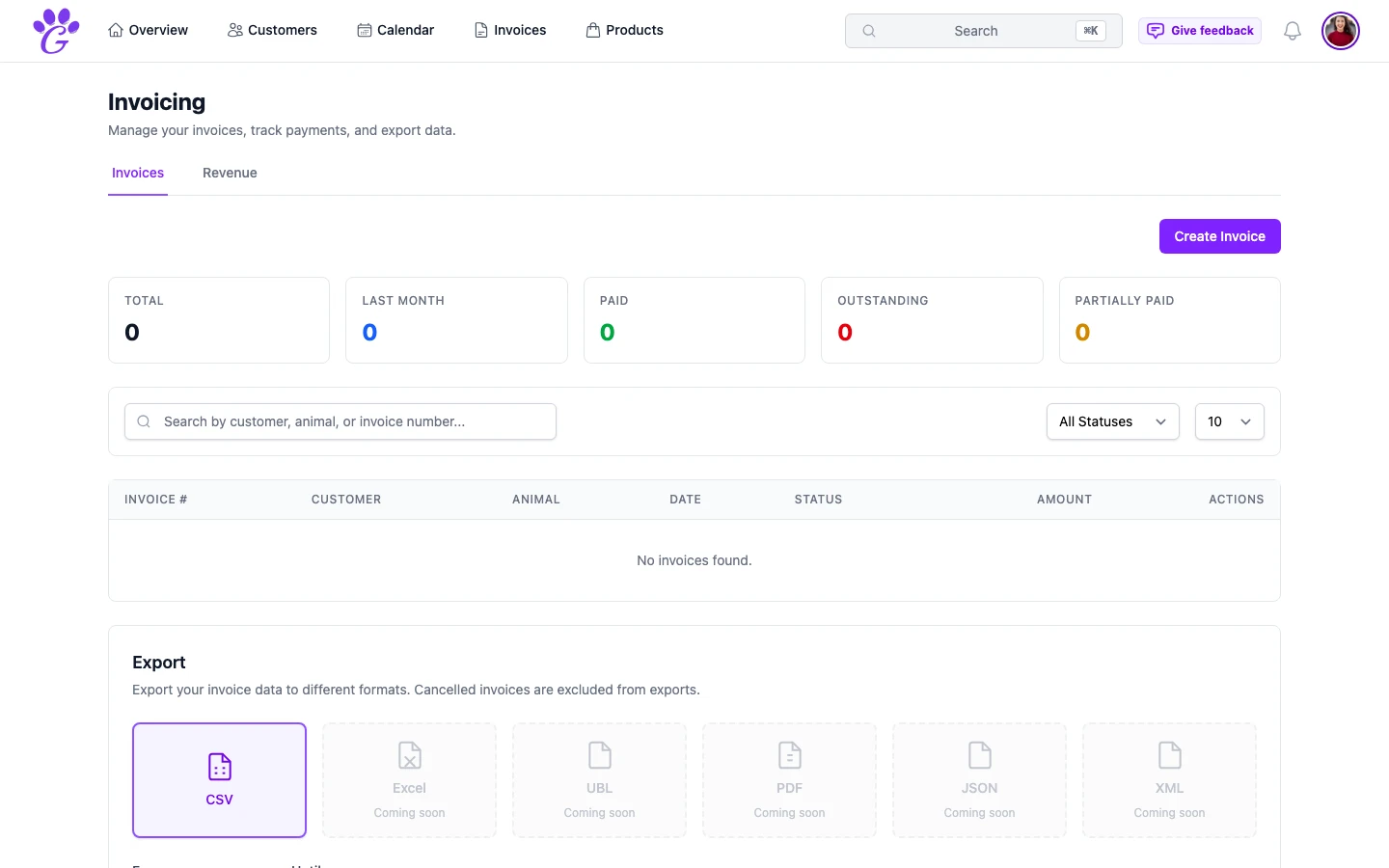
Grooming is a good living, solo or salon, when the numbers underneath are clear. The groomers who struggle are rarely the ones without clients; they're the ones running a business blind. The moment you can see revenue, costs, and take-home on one page, every pricing, hiring, and hours decision gets easier.