When to Hire Your First Employee as a Solo Groomer
The honest signs you're ready to hire: turning away clients, no vacation in 18 months, constantly running late. And the practical steps to onboard without chaos.
Hiring your first grooming employee is a decision that most solo groomers put off for a year longer than they should. The numbers might be clear, the waitlist might be real, but it still feels like a big, scary step: more admin, more liability, the end of "I just do it myself". Most of the hesitation is emotional, not financial, and understanding that is half of getting the decision right.
This isn't a piece about recruiting techniques. It's about knowing when it's time, and what the first ninety days look like so you don't unknowingly make the classic mistakes.
The signs you're actually ready
Not "busy". Ready. The difference matters.
- You're turning away clients weekly. Not occasionally, but weekly, consistently, for months.
- Your waiting list is more than four weeks long. For regulars, not just new clients.
- You haven't taken a real week off in 18 months. Because closing for a week means losing €3,000+ and a handful of clients who might not come back.
- You're running over every day. Appointments booked at 45 minutes that are taking 75. Not sustainable.
- You're saying no to the work you actually like. The complex doodles you enjoy, the show-cut scissor work, declined because you don't have time.
- Your back or wrist is starting to protest. You can't groom nine dogs a day forever; your body will eventually file a claim.
- You have the revenue to pay a salary without sweating. Specifically: your revenue could absorb €3,500–€4,500/month in personnel cost plus a small buffer.
Three of these, consistently, for a quarter. You're ready.
What often gets hired too early
Some reasons to hire that usually don't pan out:
- "Just in case we get busier." If you're not already slammed, you can't afford an idle second groomer.
- "I'm lonely working alone." Fair, but not a business case. Shared salon rental sometimes fixes this instead.
- "My partner thinks I should." Make sure you agree, not just them.
- "Someone keeps asking if I'm hiring." A person wanting a job is not a hire signal on its own.
The real cost
A full-time grooming employee in NL or DE is rarely under €3,500 per month loaded (gross + employer contributions + pension + holidays). So before you hire, your business needs to comfortably support that on top of everything else you're already paying.
- Revenue floor: roughly €4,500 per month of new, additional revenue, not just the second groomer splitting yours.
- Ramp time: new groomers need 4–8 weeks to hit full productivity. Budget accordingly.
- Training time: you'll spend about 8 hours per week in the first month teaching salon-specific things. That's 8 hours less of your own grooming.
If your maths doesn't work with those numbers, you're not ready.
How to find the right person
A few principles that save time and heartache:
- Skill over personality on day one. A warm, welcoming, charming person who can't hand-scissor a doodle will still need to learn, slowly. A quiet introvert with strong scissor skills can grow on clients and deliver quality.
- Trial shift before hiring. Even paid for a day: have them groom a couple of simple dogs. Watch technique, calmness under pressure, how they handle a nervous dog.
- Check references with their last groomer employer. Two questions: "Would you hire them again?" and "What was the hardest thing about working together?"
- Look for apprenticeship-ready attitude. Someone willing to learn your specific ways is better than someone locked into a different salon's habits.
- Cultural fit with clients matters. Your clients chose you for a reason; the new person becomes part of that experience.
The first 90 days
Where most first hires fail is not the hiring; it's the onboarding.
Days 1–14
- They shadow you for two days. Nothing else.
- Then they take simple bookings (bath and tidy, Yorkie-size full grooms) with you in the room.
- Daily debrief at 5pm, 15 minutes. What went well, what didn't.
Days 15–45
- They handle their own clients, with specific complexity limits (no de-matting, no aggressive dogs).
- You review every appointment for the first two weeks.
- Introduce them to clients personally; don't just add them as a "new groomer" on the booking page.
Days 46–90
- They're grooming independently across most of the schedule.
- You're pulling back on shadow reviews.
- Start handing over specific clients as "theirs".
- First formal check-in at 90 days: how do they feel, how do clients feel, how do the numbers look.
The tools matter more than you think
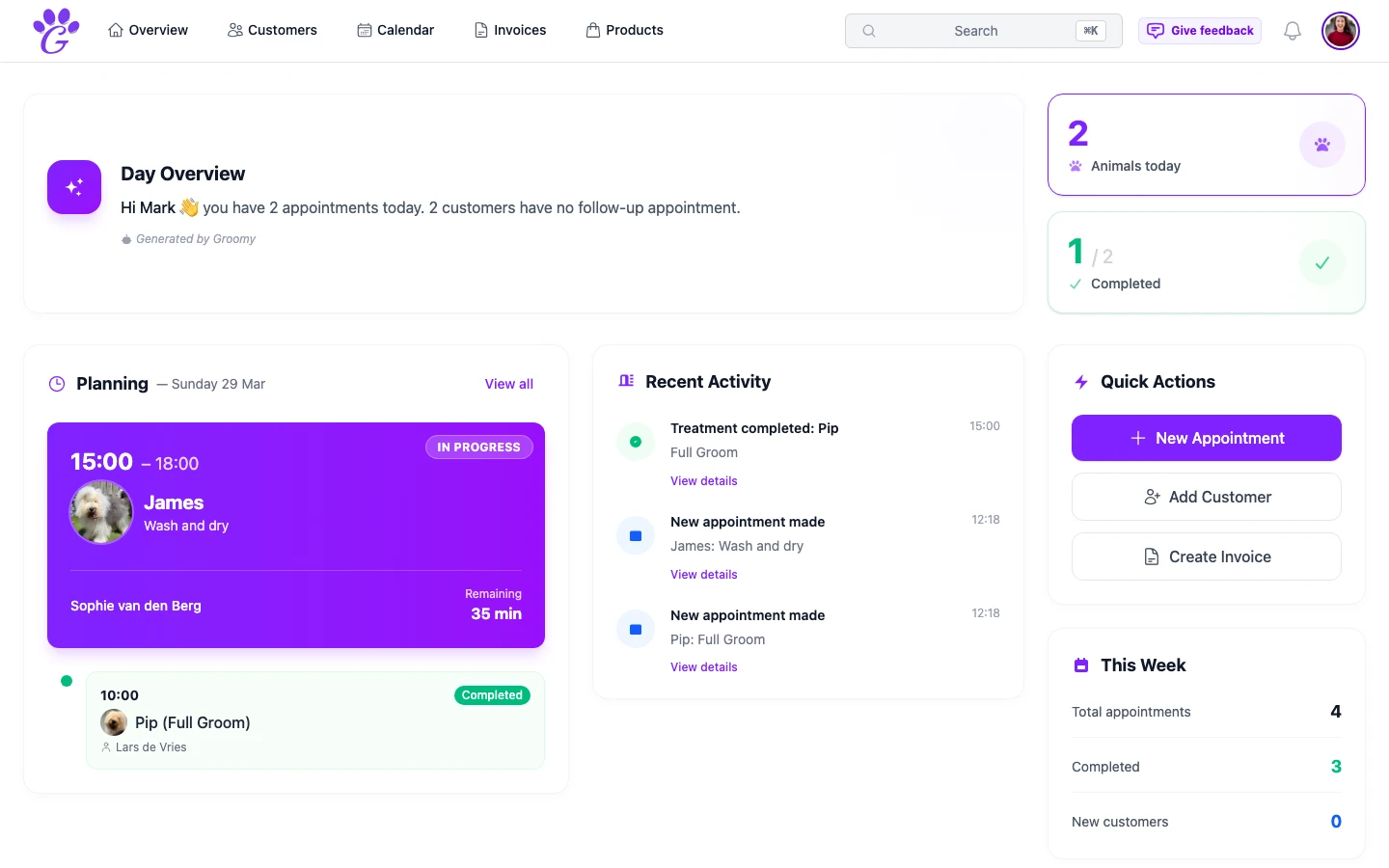
Your grooming software should grow from solo to team on day one, not require a migration, and not require you to "figure it out".
- Invite them by email. Their own login, and every appointment shows who it's assigned to.
- Set their working hours. Online booking only offers times they're in.
- Role-based access. They don't see financials they don't need to see.
- Per-groomer revenue. Only for you. Not exposed to the team unless you choose.
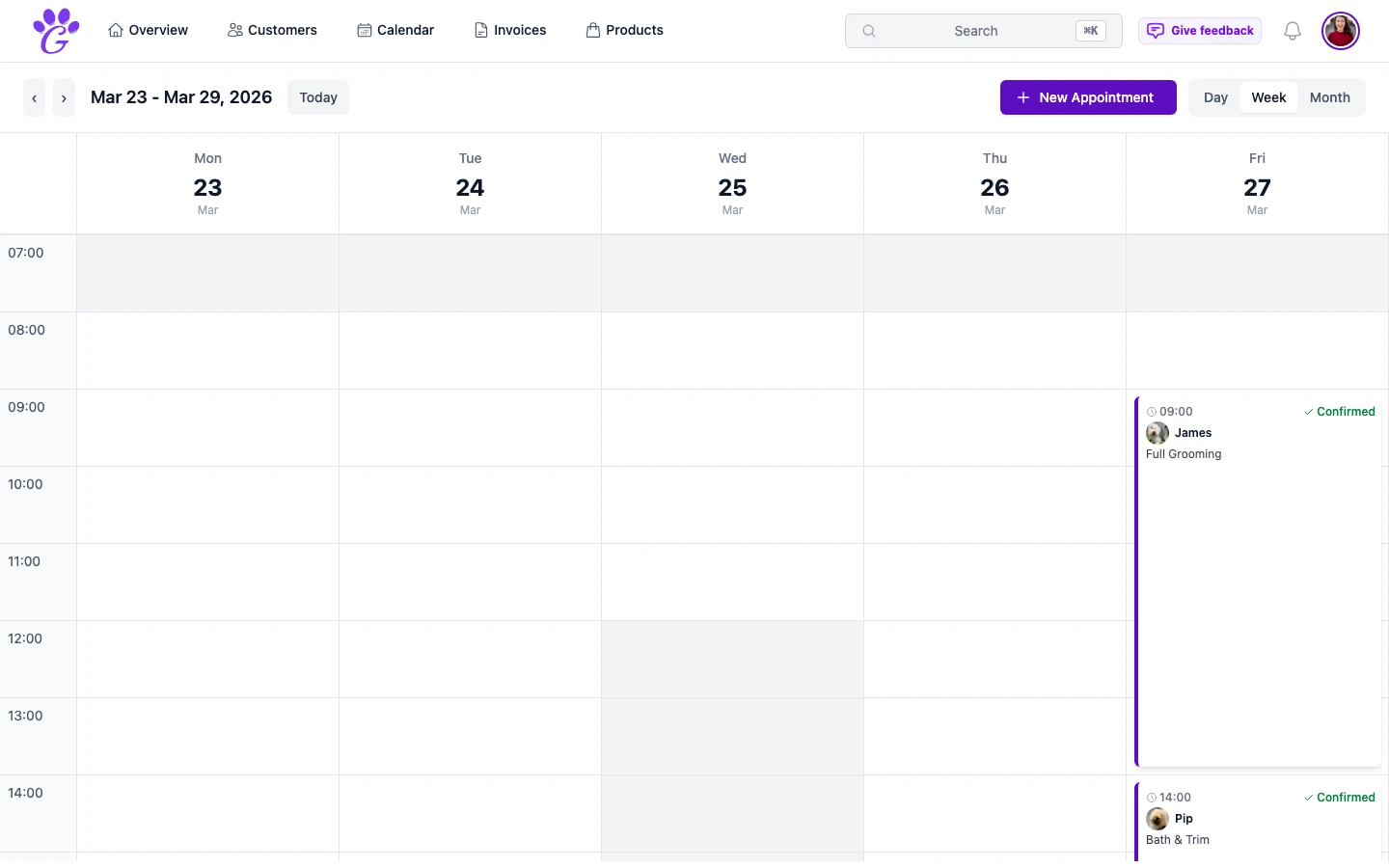
- Same calendar, filtered by groomer. See the whole salon, or just one person's day.
If your current tool can't do this cleanly, hire onto software that can, before the hire, not after.
The emotional part
Hiring is a small grief, honestly. The way you've done things for years changes. A dog you've groomed for three years might get a different scissor hand next time. Clients who think of you as "their" groomer meet a new face. You stop being the salon; you become the salon plus one.
That feeling is normal, and it goes away within a couple of months. What replaces it is a week off without guilt, a waiting list you can finally offer a slot to, and a salon that isn't entirely dependent on one person's wrist holding up.
Hiring your first employee is not a leap; it's a series of small, specific decisions made in the right order. The hardest part is deciding the business is genuinely ready. The rest (the job ad, the interview, the onboarding) is a set of steps that, done with care, lead to a salon with room to breathe for the first time in years.