How to Manage a Grooming Salon With Multiple Groomers
From solo to a team salon: scheduling conflicts, shared vs individual calendars, client allocation, and the small systems that keep a multi-groomer salon running.
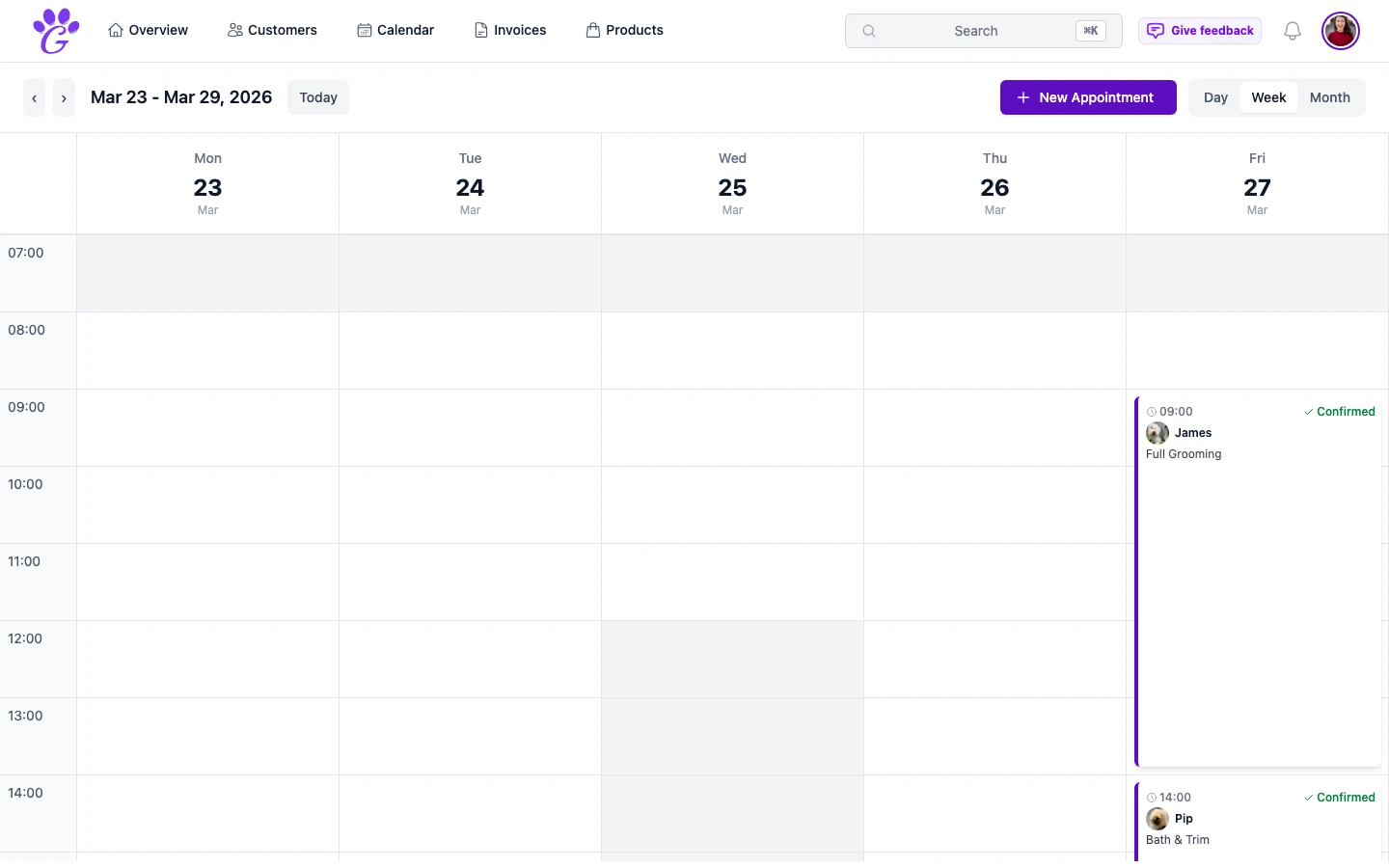
The jump from solo groomer to running a salon with one, two, or more groomers is where most salon owners hit a wall they didn't see coming. Solo grooming is a craft: you and the dog, all day. Running a team is a management job, and the skills don't transfer as cleanly as most people hope. The good news is that managing a multi-groomer salon isn't about being a different person; it's about putting a few specific systems in place that make the coordination easier than the chaos.
This isn't a piece about hiring. It's about what happens the moment there are two chairs in the room instead of one.
The three problems that hit first
Most multi-groomer salons trip on the same three issues in the first three months:
- Double-booking. Two people editing the same schedule, or taking phone calls at the same time. Without conflict detection, it happens weekly.
- Who gets which client. New bookings arrive; who grooms them? Your longest-tenured regular might expect you; your new groomer is idle.
- Invisible workload. The owner-groomer is worked to the bone; the second groomer has two short days a week. Nobody realises until someone quits.
Each of these has a clean solution. Most of them are calendar features, not personality issues.
Shared calendar or individual
The first architectural question: do your groomers share one calendar, or each have their own?
- Individual calendars (parallel columns): each groomer sees their own day. The owner sees all columns at once. Best for most salons.
- A shared calendar: everyone edits the same timeline. Simpler for very small teams; breaks down past two people.
- Hybrid: individual calendars for grooming, shared calendar for salon-wide events (deep clean, supplier visits).
Pick one and commit. Switching half-way is painful.
Client allocation
The subtle decision: when a new booking comes in, which groomer takes it?
- Random / balance-based. Whoever's less busy gets the next one. Fair, but feels impersonal.
- Specialty-based. Doodles to the doodle specialist, handstrips to the terrier specialist. Professional, but harder to manage.
- Geographic (for mobile salons). Whoever's nearer.
- Client-locked. A regular always goes to "their" groomer. Best for loyalty, worst for holidays.
- First-available. Whoever's free at the time the client wants. Simplest. Usually fine.
Most salons end up with a mix. Regulars are client-locked; new bookings are first-available; specialities route by expertise.
Daily rhythms
A team salon needs rhythms a solo salon doesn't:
- Morning huddle, 5 minutes. Who's in, who's out, any special-handling dogs today, who's handling supplies.
- Handoff window. If groomers overlap shifts, build in 15 minutes of overlap so the outgoing person can brief the incoming one.
- End-of-day check. Anything outstanding: an unpaid invoice, an unbooked rebook, a note someone forgot to write.
- Weekly review. Fifteen minutes on a Friday, looking at revenue, no-shows, complaints, and next week's workload balance.
Ten minutes per day. Avoids hours of confusion per week.
Keeping it fair
Most quiet resignations in grooming salons come from unfair workload. Not volume, but fairness. A groomer with all the easy dogs resents nothing; a groomer with all the difficult ones, week after week, quietly burns out.
- Rotate the hard dogs. The biting dog, the Doodle with matted armpits, the Malamute blow-out. No one does the same tough ones every week.
- Rotate short and long appointments. Nobody does a full day of small baths; nobody does a full day of hand-strips.
- Rotate the admin tasks. Tidy, restock, wash towels, answer the door. Spread evenly.
- Check revenue per groomer monthly. Not to compare, but to check nobody is systematically assigned low-revenue work.
The owner problem
In small salons, the owner is usually also a groomer. This is the hardest role to do well.
- Block owner time. Two to four hours a week where the owner doesn't groom. Paperwork, scheduling, supplier orders, staff check-ins. If you don't block it, it doesn't happen.
- Don't take all the hard ones "because you can". You'll burn out, and your team learns that the hard dogs are yours forever.
- Don't take all the easy ones either. You'll resent your team, and they'll notice.
- Delegate visibly. If you're not going to trust your second groomer with a new client, why did you hire them?
What the tools need to do
A few non-negotiables for multi-groomer grooming software:
- Every groomer's appointments in view: the groomer on each appointment, and a filter to show one person at a time.
- Easy reassigning: moving a dog from one groomer to another on a busy day is a common action.
- Per-groomer working hours: not everyone is in every day.
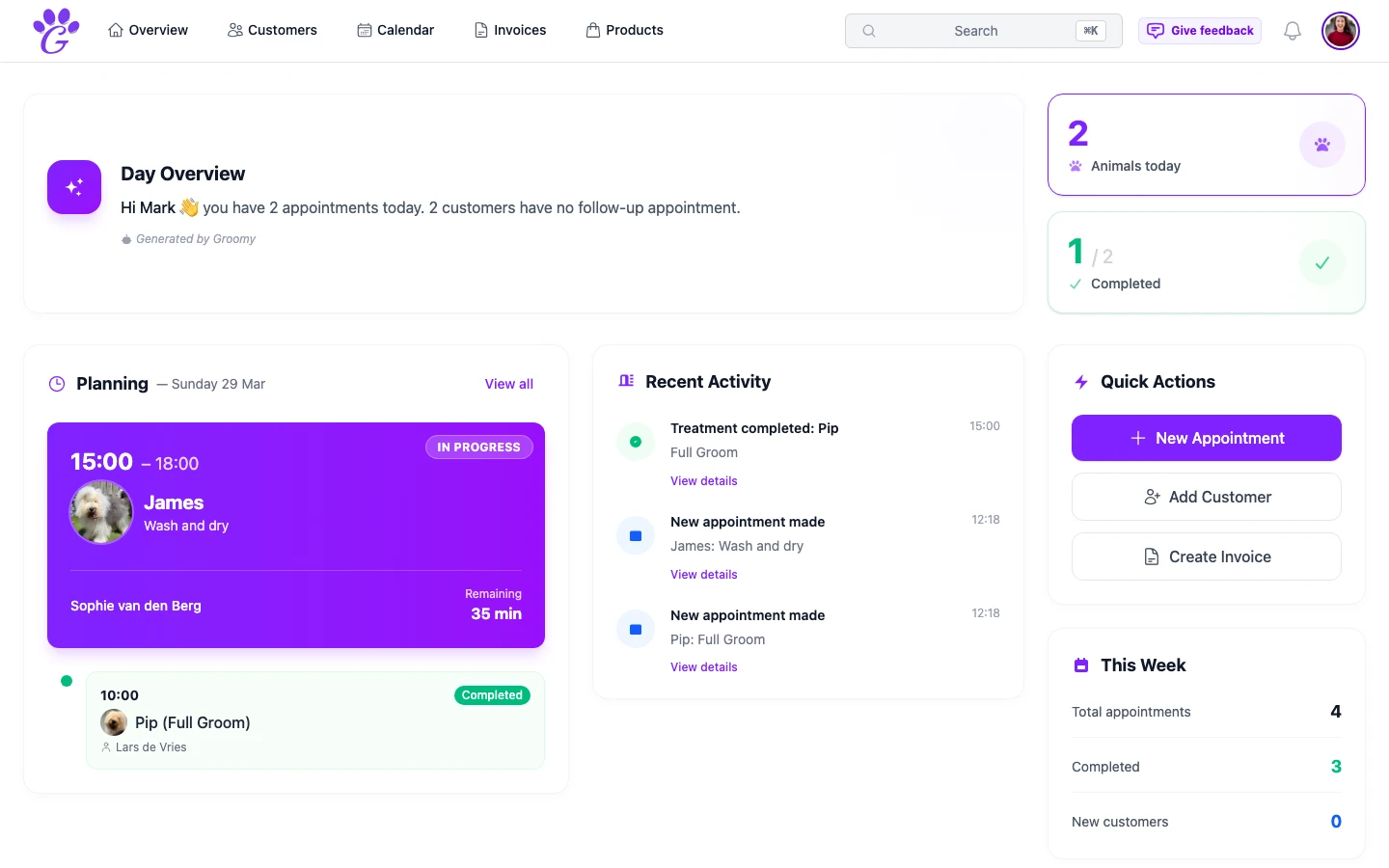
- Dashboard filter: "my day" vs "whole salon".
- Revenue by groomer: visible to the owner, not forced on the team.
- Individual login per person: no shared passwords.
- Role-based access: receptionists don't need to see financials.
If your current tool can't do these, it's not multi-groomer software; it's solo software with extra seats.
Growing past three
Two groomers run on relationships. Three run on systems. Four need a receptionist.
- Three groomers is where a weekly schedule meeting becomes essential, not optional.
- Four groomers is where phone calls alone break the owner. A receptionist (or at least a shared inbox and online booking) becomes necessary.
- Five or more is where the owner stops grooming regularly. Not because they want to, but because the business needs them on it, not in it.
Plan for the next headcount before you hit it.
Managing a multi-groomer salon isn't a harder version of grooming; it's a different job. A few small systems, applied consistently, do most of the work. Your calendar handles scheduling; your dashboard handles visibility; your weekly rhythm handles everything else. What's left is the craft, and a team that's actually working together instead of around each other.