Tax Season for Pet Groomers - What You Need to Know
A practical January guide for solo groomers and salon owners. What's deductible, how to organise invoices, VAT in NL/DE/UK, and why year-round tracking beats a last-minute scramble.
Most groomers don't love January. It's the quieter trading month, which would be fine, except it's also when last year's tax return is due, and the receipts have been piling up in a shoebox since April. A weekend that should have been for rest turns into a furious reconciliation of invoices, cash slips, and bank statements.
The tax fix isn't actually about January. It's about the rest of the year. Groomers who close each month cleanly (digital invoices, marked paid, VAT tracked automatically) spend an hour on the year-end, not a weekend. This is a practical guide to being one of them.
What's actually deductible
Across NL, DE, and the UK, the deductions for grooming businesses are broadly similar. The exact rules differ; always verify with your accountant, but these are the usual categories:
- Products and consumables: shampoo, conditioner, cologne, ear cleaner, styptic powder, towels.
- Equipment and tools: clippers, blades, scissors, dryers, tables, bath fittings. Larger items depreciate over multiple years.
- Training and certification: continuing education, professional courses, industry events.
- Rent and utilities: salon lease, electricity, water, gas, internet.
- Insurance: public liability, professional indemnity, inventory.
- Vehicle costs: for mobile groomers, or if you drive to collect supplies. Usually a per-kilometre allowance or actual cost method.
- Software and subscriptions: grooming software, accounting software, email marketing.
- Professional services: accountant, lawyer, consultancy.
- Uniform and safety: aprons, gloves, non-slip shoes used specifically for the job.
- Marketing and advertising: website hosting, ads, printed flyers, photo shoots.
- Phone and internet: the business share.
- Bank and payment processing fees: card readers, transaction fees, business banking charges.
A good rule of thumb: if it's an expense you wouldn't have if you weren't a groomer, it's probably deductible. An accountant will catch the edge cases.
VAT basics by country
The three markets this guide covers:
- Netherlands: 21% standard VAT rate on grooming services. Small-business scheme (KOR) available under €20,000 turnover.
- Germany: 19% standard MwSt. on grooming services. Kleinunternehmerregelung available if net turnover stayed under €25,000 last year and stays under €100,000 this year; go over €100,000 mid-year and the sale that crosses the line is already taxable.
- United Kingdom: 20% VAT on grooming services. Registration required once turnover exceeds £90,000.
If you're below the threshold and registered for the small-business scheme, you don't charge VAT on invoices, but you also can't reclaim VAT on purchases. Whether that's a net benefit depends on how much you spend on VAT-bearing supplies.
Organising invoices year-round
The single highest-leverage habit for grooming tax season is not something you do in January; it's something you build into the month.
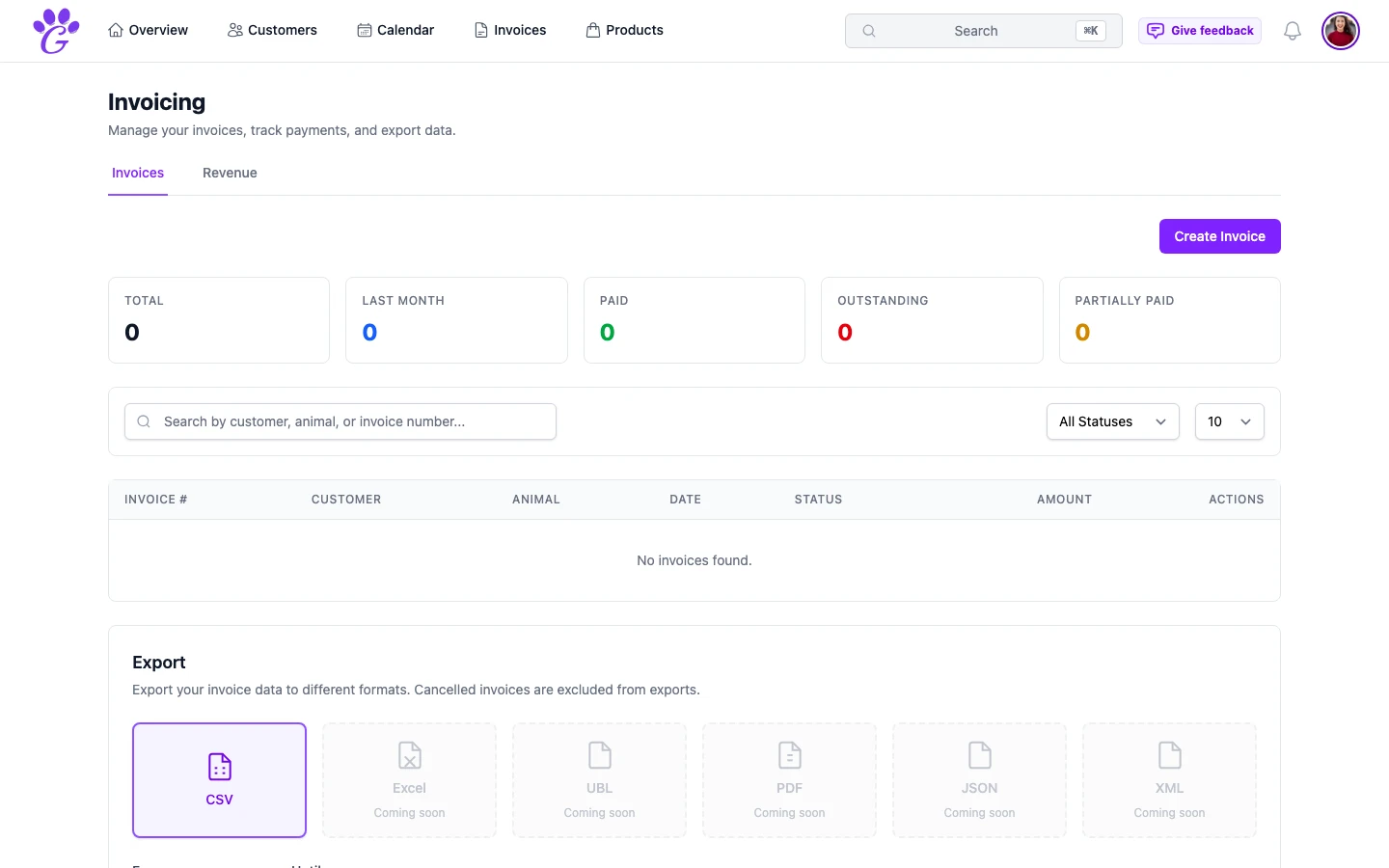
- Every sale gets a digital invoice. Cash, card, bank transfer, all of it. Paper receipts drift away; digital records don't.
- Mark invoices paid on the day they're paid. Not "at the end of the week". Same day.
- Categorise every expense. When a receipt enters your inbox, tag it immediately (products, rent, equipment, travel). Two seconds per receipt.
- Reconcile monthly. Thirty minutes on the first of the month: bank statement against invoices and expenses. Any discrepancy is fresh and easy to resolve.
- Back up. If it's in cloud software, it's already backed up. If it's in a spreadsheet or a folder, copy it to a second location.
After a year of this, the tax return is not a weekend; it's an export, a check, and a submit.
What to give your accountant
A well-prepared groomer's tax packet usually includes:
- Revenue export: all invoices for the year, with line items, dates, customer, VAT rate and totals. CSV format is standard.
- Expense receipts: categorised, ideally in a single folder per category.
- Bank statements: full year, all accounts used for the business.
- VAT returns already filed: quarterly submissions if you're VAT-registered.
- Mileage log: if you drive for business.
- Depreciation schedule: equipment bought in previous years that's still being written down.
- Anything unusual: a grant, a large one-off expense, a change in business structure.
Accountants charge by time. A well-organised packet can cut their fee significantly.
The "I'm behind" recovery plan
If you're reading this in January and the shoebox is groaning, it's not hopeless.
- One afternoon, sort the shoebox into: revenue, products, equipment, rent/utilities, vehicle, other.
- Reconstruct invoices from your bank statements. Every incoming payment should be traceable to a grooming job.
- Start digital from February. Don't try to digitise the whole past year; just stop making it worse.
- Tell your accountant honestly. They've seen it before, and they'd rather have messy data than missing data.
Recovery takes one painful weekend. The following year is a different story.
Common groomer mistakes
A few patterns accountants see again and again:
- Mixing personal and business bank accounts. Painful to unpick retrospectively. Fix: separate accounts from day one.
- Claiming 100% of a phone or car that's mixed-use. Most tax offices expect a realistic business-share split.
- Forgetting continuing education. Groomers often pay for courses out of pocket and forget they're deductible.
- Under-claiming depreciation. A €1,200 stand dryer bought three years ago is still depreciable.
- Missing VAT on small invoices. Every invoice needs the VAT row, even when the amount is small.
Planning for the next year
After the return is filed, spend thirty minutes setting yourself up for a cleaner year ahead.
- Create a dedicated "receipts" email folder. Everything related to grooming costs goes here.
- Set a monthly reminder for the first of each month: reconcile last month.
- Decide on an accounting software or grooming platform that exports what you need.
- Ask your accountant what they wish you'd send. Their answer is your system for next year.
Tax season isn't inherently awful. What makes it awful is pretending it doesn't exist for eleven months and then trying to rebuild the year in a weekend. A little rhythm through the year (digital invoices, monthly reconciliation, clean categorisation) turns the return into what it should be: a check, a signature, and a cup of coffee.