How to Start a Dog Grooming Business: The Setup Checklist
Setting up a dog grooming business? A practical checklist: training, licensing, insurance, kit, pricing and first clients, plus UK, NL and DE rules.
Opening a dog grooming business can look overwhelming from the outside: certifications, insurance, equipment, software, pricing, marketing, taxes. In practice, none of those are hard on their own. What trips people up is doing them in the wrong order, or forgetting the small things that come back to bite a month after you open.
This is a practical checklist from the perspective of someone opening their first grooming business. It's not the most romantic part of the trade, but the rest of grooming gets much more enjoyable once these basics are in place.
Before you sign anything
- Train and certify properly. National certifications carry weight, but a solid practical apprenticeship matters more day-to-day. You should be confident on breed patterns, hand-scissoring, clipper work, handling nervous dogs, and basic health assessment before you take paying clients.
- Talk to working groomers. Buy coffee for people five and ten years into the trade. Ask what they wish they'd known. One honest conversation saves months.
- Find out what your country actually asks for. Whether grooming needs a licence, what you register as, and when you start charging VAT are decided nationally, not by the trade. There's a section below that answers this for the UK, the Netherlands and Germany; if you're somewhere else, your local authority and an accountant will close it in two phone calls.
- Write a one-page plan. Not a business-school document. One page: who you are, what you offer, what it costs, what it costs you, how many dogs per week you need to break even. You'll revise it often; that's fine.
Decide on your model
- Mobile, home salon, or shop. Mobile needs a van and the logistics that come with it. Home salon is cheapest to set up but limits growth. A shop is the biggest upfront commitment but the easiest to scale.
- Services. Full groom, bath-and-tidy, hand-strip, de-shedding, puppy introductions, teeth, nails. Don't try to offer everything on day one; add as you gain confidence.
- Target clientele. All breeds, or a specialty (doodles, hand-strip terriers, cats, seniors)? A specialty lets you price better and attract the exact clients you want.
Legal and financial
- Register the business. Pick a structure (sole trader or a company), register it, and register for VAT if you're over the threshold where you trade. The country details are in the next section.
- Open a separate bank account. Never mix personal and business money, even if you're a one-person business.
- Get insurance. Public liability, cover for the dogs in your care, and property cover. Some clients ask to see it before booking.
- Set up bookkeeping. Decide early whether you'll do it yourself or hire an accountant. Either way, you need a system for receipts from day one.
- Understand your taxes. VAT, income tax, social contributions, quarterly deadlines. Get a 30-minute conversation with a local accountant before you open, not after.
Where you are: UK, Netherlands, Germany
Wherever you groom, the same four questions decide whether you're legal on opening day: what you register as and with whom, whether grooming itself needs a licence, when you have to start charging VAT, and what insurance you're expected to hold. Here's how those land in the three markets we know best.
- United Kingdom: register as a sole trader with HMRC for Self Assessment, or set up a limited company at Companies House. Grooming on its own is not one of the five licensable activities under the Animal Welfare (Licensing of Activities Involving Animals) (England) Regulations 2018 — but day care for dogs and boarding are, so the moment you keep dogs beyond the groom you need a licence from your council. Scotland, Wales and Northern Ireland run their own schemes, and a home salon may need planning permission for change of use either way, so start with a call to the council. VAT is 20%, and registration becomes compulsory once turnover exceeds £90,000. Insurance: public liability plus care, custody and control cover for the dogs themselves; employers' liability is a legal requirement the moment you take on staff, including part-timers and apprentices.
- Netherlands: register with the KVK (Kamer van Koophandel), usually as an eenmanszaak, and you'll receive a KVK number and a btw-id. There's no national grooming licence: the proof-of-competence rules in the Besluit houders van dieren are aimed at businesses that house animals — pensions, kennels, breeders — so a salon that grooms a dog and hands it back the same day sits outside them. Add day care or boarding and you're inside them. Municipal rules on premises, waste water and noise apply regardless. VAT (btw) is 21%; the small-business scheme (KOR) is available under €20,000 turnover, and under it you don't charge btw and can't reclaim it. Insurance: a bedrijfsaansprakelijkheidsverzekering is the baseline, usually extended to cover damage to animals in your care.
- Germany: file a Gewerbeanmeldung with your local Gewerbeamt, describing the services precisely on the form. Straightforward grooming doesn't need a permit under §11 of the Tierschutzgesetz; adding boarding, selling animals or commercial training does, and that brings the Veterinäramt into it. VAT (MwSt.) is 19%; the Kleinunternehmerregelung is available if last year's turnover stayed under €25,000 and this year's stays under €100,000. Insurance: a Betriebshaftpflichtversicherung, with an explicit extension for damage to animals in your care (Obhutsschäden).
Rules and thresholds change, and this is the shape of the answer rather than advice for your specific case. Confirm the current detail with your local authority and an accountant before you register anything.
Equipment (the real list)
Starting kits are always bigger than you think. Buy quality for anything that touches the dog; save money on the rest.
- Table with restraint: quality matters; a wobbly table slows every groom.
- Clippers and a proper set of blades: 10, 7F, 5F, 4F are a reasonable starting set.
- Scissors: straight, curved, thinning. Professional scissors are an investment that pays itself back.
- Dryer(s): a shop dryer and a stand dryer are ideal; start with one good stand dryer if budget is tight.
- Bath setup: hydraulic bath, shower with variable pressure, non-slip mats.
- Brushes and combs: slicker, pin brush, fine and coarse combs, dematter.
- Consumables: shampoo, conditioner, cologne, ear cleaner, nail powder.
- Towels: twice as many as you think you need.
- First aid kit. Dog-specific. Include styptic powder and a muzzle.
- Vacuum and cleaning supplies: you'll use these more than you expect.
Your pricing
Pricing is where most new groomers underestimate themselves. A few principles:
- Cover real costs, then add your time. Don't reverse-engineer from what the salon down the road charges.
- Price by breed or breed group, not a single rate for "small / medium / large".
- Add line items for de-matting, extras, and behavioural difficulty.
- Review annually, not whenever you feel guilty.
If you need a framework, start with the blog post on pricing grooming services fairly, and then adjust for your specific region and costs.
Your tools and software
Whatever you pick here sets the rhythm of your business for years. Pick well and you don't think about it again. Pick poorly and it silently eats your time.
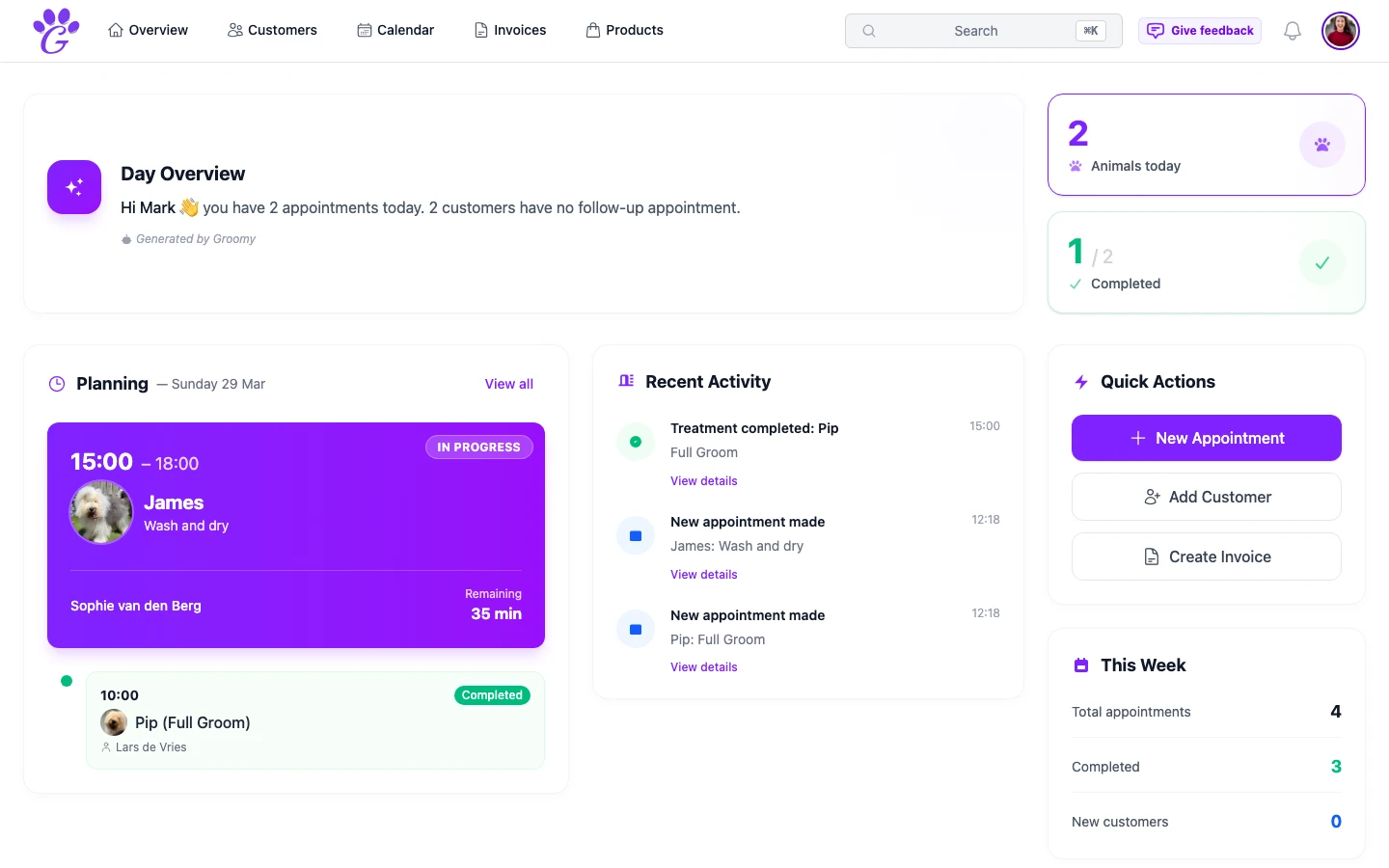
- Scheduling and client records: purpose-built grooming software, not a generic calendar.
- Invoicing: digital, VAT-capable, PDF-ready.
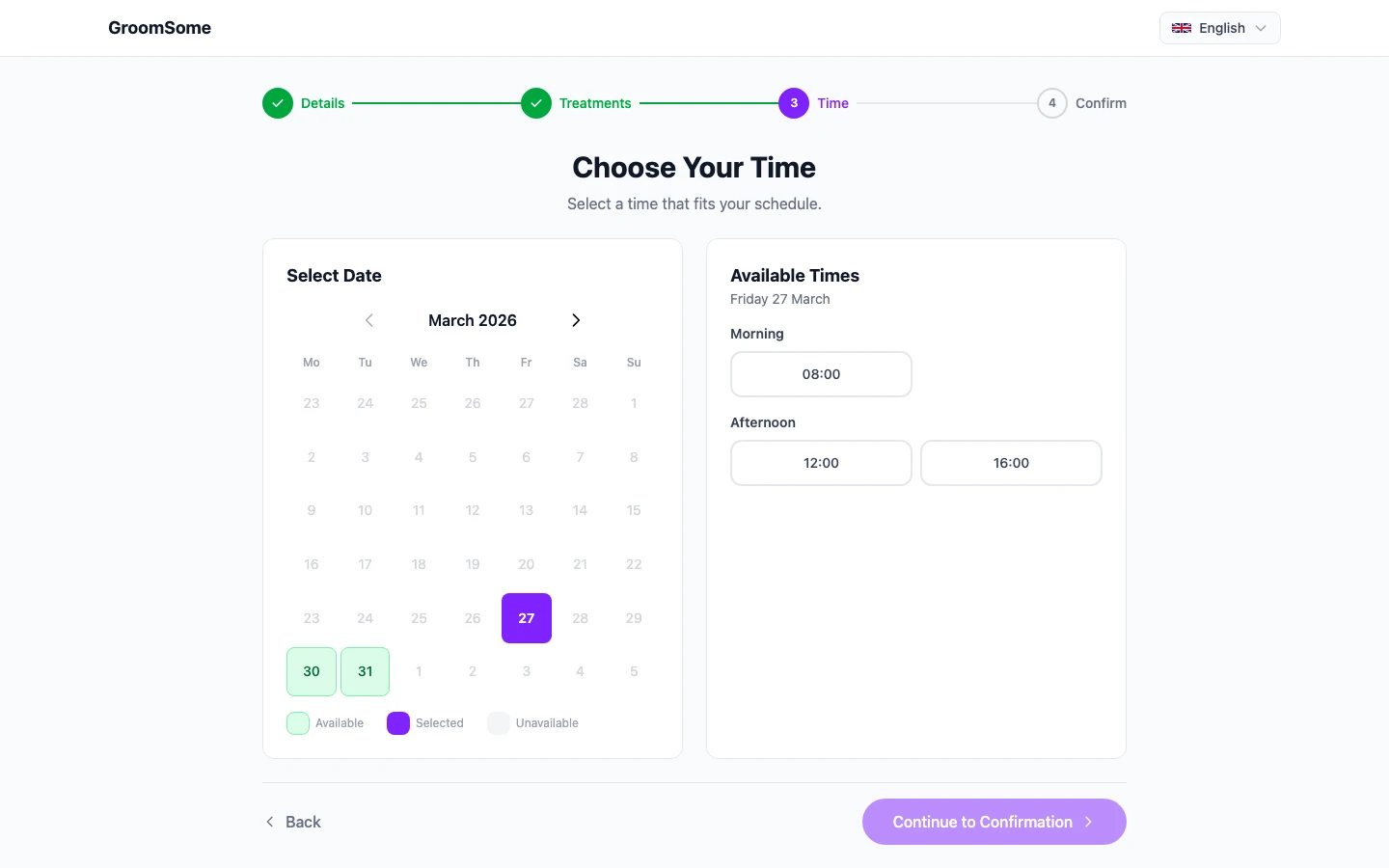
- Online booking page: even if you only accept a few online bookings at first.
- Reminders: automated, from day one. New clients don't yet trust you enough to remember.
- Revenue dashboard: you need to see the numbers every month, not once a year.
Marketing to actually get your first clients
You don't need a big marketing strategy. You need about three things that are good enough.
- Google Business profile. Set it up before you open. Fill every field. Upload ten real photos.
- Instagram or TikTok. Before/after photos of real dogs, posted consistently. Not ads.
- A booking link. On your profiles, your invoices, your door. Make it the easiest thing about you.
- Word of mouth setup. Every happy client is asked, at the till, to leave one review. This is the single most effective thing a new groomer can do.
The first 90 days
Three practical goals for the first three months:
- Fill your week to 50% capacity. Not 100%. You need slack to absorb the new-client chaos.
- Build up 10 reviews. Ask every happy client; most will.
- Close your first month of books cleanly. Invoices, expenses, taxes: all in one system.
If you're solid on those three, the rest takes care of itself.
Opening a grooming business is mostly a list of small, boring tasks done in the right order. None of it is hard on its own. The groomers who make it are the ones who don't wait until they're "ready" to start; they start with the basics in place and learn the rest in public. That's how every busy salon you admire began.