Pet Grooming Software vs. Pen and Paper (2026) - What You're Really Losing
An honest comparison. Paper works fine for some salons, but here's where it silently breaks down, and when switching is worth the hassle.
Every grooming salon has an origin story with a pen in it. A small notebook, a wall calendar, a spiral diary with a dog sticker on the front. Nothing wrong with that. For a solo groomer with a tight regular client list, a paper book can genuinely be the right tool: light, fast, no screen between you and the dog. Most of the problems start later.
This isn't a piece about how paper is bad. It's about the moment paper stops being enough, and what it actually costs you to wait longer than that. If you're still happy with your diary, you might not need to switch. If some of this sounds familiar, you probably do.
What paper does well
Be fair to the diary first. It has real advantages.
- No learning curve. If you can write, you can schedule.
- No login, no outage. The book is always "up".
- Tactile context. Some groomers remember where a booking is on the page as well as what it says. That's a real thing.
- Cheap. A good book costs less than one appointment.
- Private. Nothing syncs anywhere. Nothing is stored in a server you don't control.
For a solo groomer doing twenty regular dogs a week, in a known pattern, with no second groomer and no online presence, paper is fine. Honestly.
Where paper starts to leak
The trouble with paper isn't that it fails dramatically. It's that it fails invisibly. Each leak on its own is small enough to shrug off. Together, they're a real hole.
- Double-bookings. Two dogs in the same slot because someone called while you were holding a dryer. The only fix is memory, and memory fades.
- Lost client info. A number scribbled in the margin, a dog's name you can't quite read three weeks later, a vet's phone number on a sticky note that fell off.
- No searchable history. A client asks "what did you do for Bella last time?" and you flip through pages hoping to find a date you can't quite remember.
- No reminders. If you don't phone each client the day before, there's no buffer between their forgetfulness and your empty slot.
- No revenue picture. At the end of the month, you know you were busy. You don't know if you earned more or less than last month. You don't know which service makes money and which costs you time.
- No backup. The book is one accident (a coffee, a gust of wind, a puppy) away from disappearing.
- Tax season chaos. Paper invoices plus handwritten notes plus a shoebox is the reason every January feels like a bad month.
When paper definitely isn't enough anymore
Some signs are subtle. Others are impossible to ignore. If any of these are you, the book is costing you money:
- You've double-booked more than once in the last three months.
- You spend any time at the end of each day "tidying up" your schedule.
- You have no idea who last came in six months ago and hasn't rebooked.
- You've lost a client's phone number permanently.
- You're about to add a second groomer.
- You're planning to take online bookings.
- Your tax return genuinely hurts.
Any single one of those is usually enough. Two or three means paper has already stopped paying for itself.
What software actually replaces
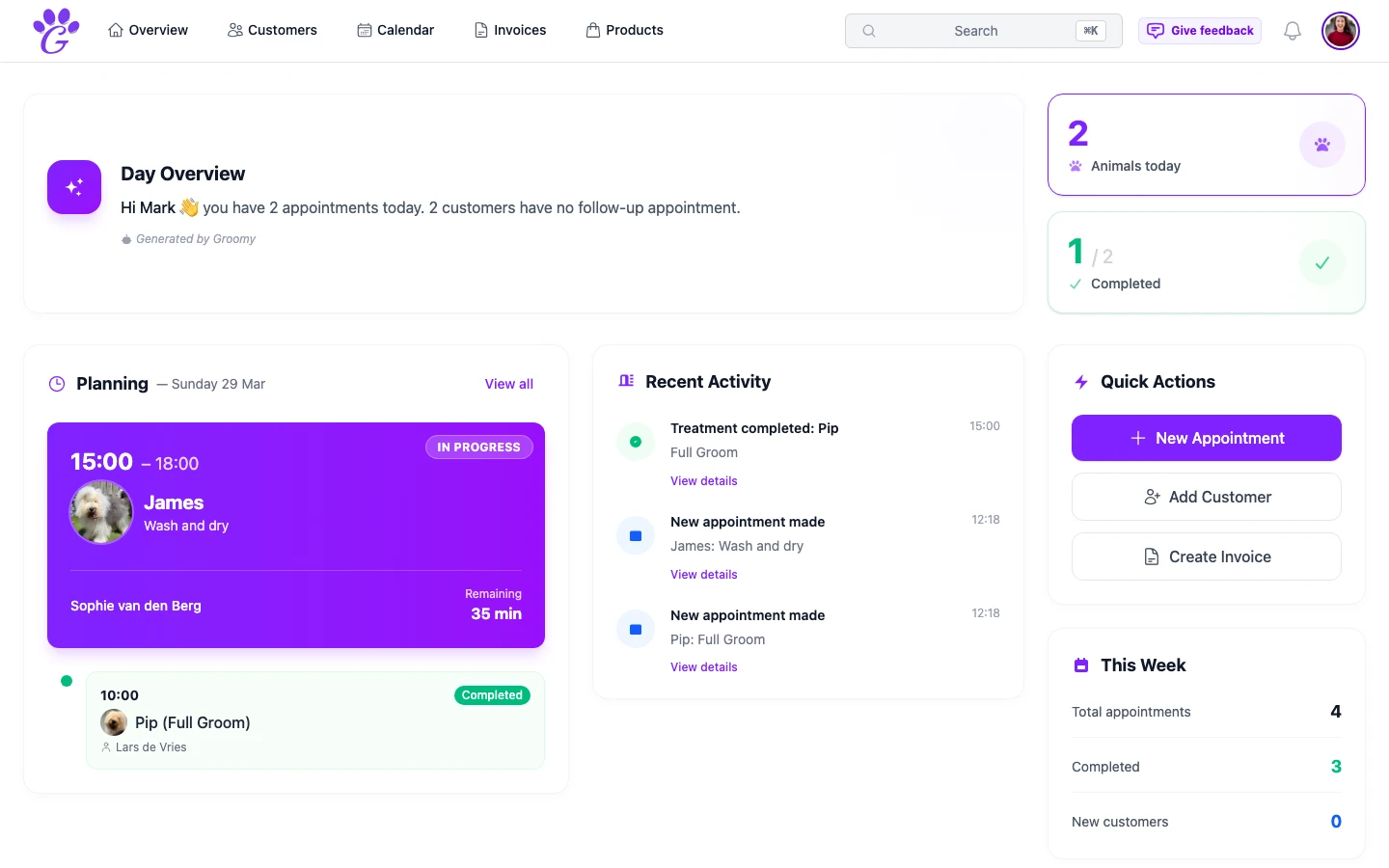
When groomers hesitate to switch, it's often because "software" sounds like a big, generic thing. In practice, good grooming software replaces a very specific list of small frustrations:
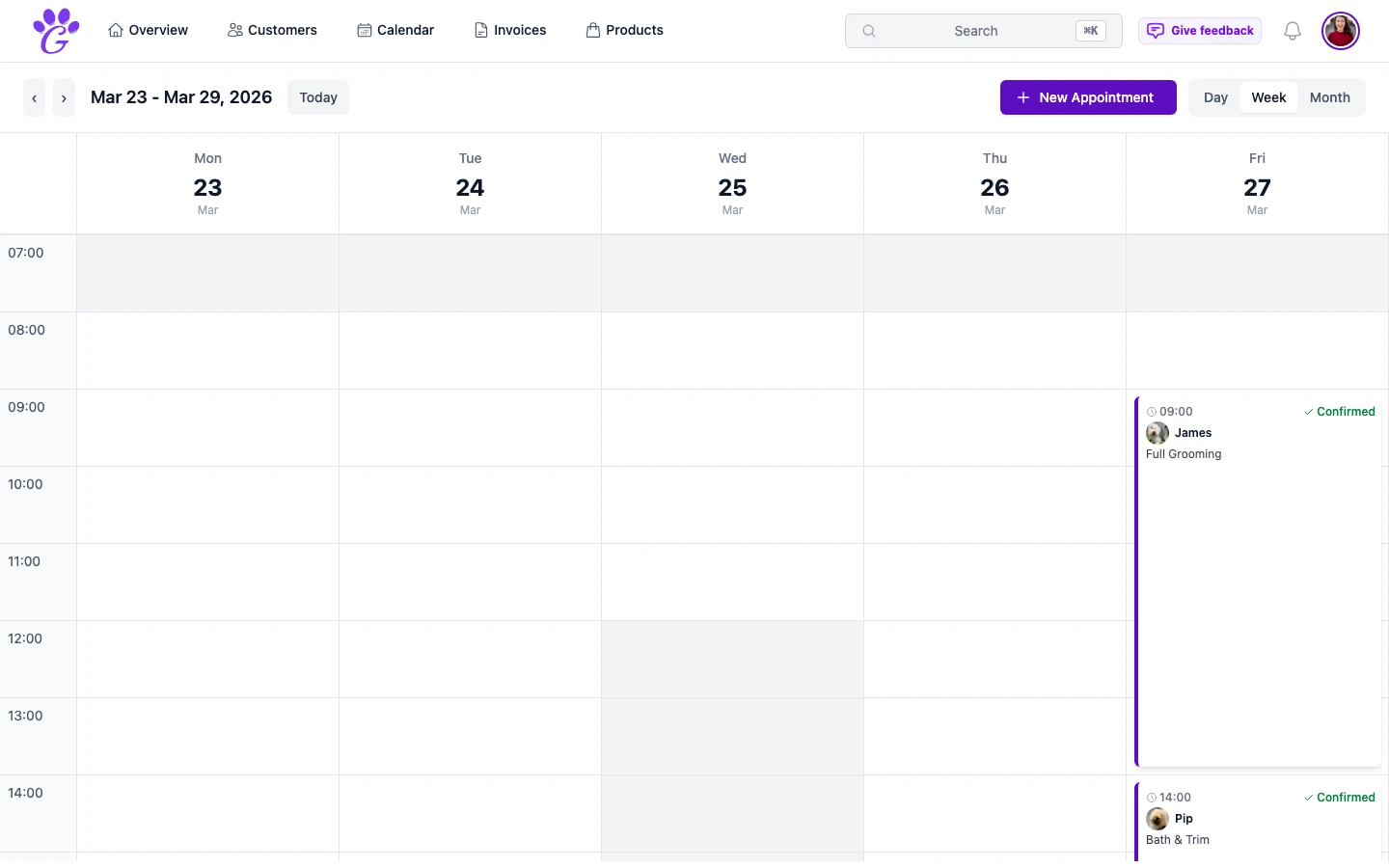
- The diary → a visual calendar with day/week/month views, colour-coded by appointment status.
- The client notebook → searchable customer and pet records with vet info, medical notes, and behavioural flags.
- The margin scribbles → structured notes and photos per pet, so you never squint at your own handwriting again.
- The manual reminder phone calls → automated email reminders, with SMS as a paid add-on.
- The shoebox of invoices → digital invoices, tax breakdown, PDF download, and CSV export for the accountant.
- The gut feeling → a revenue dashboard so "was this a good month?" has a real answer.
- The daily backup panic → secure cloud storage, so nothing is one spilled coffee away from lost.
What software isn't
Let's be honest about the limits too.
- It's not instant on day one. You'll need a few days to get comfortable and a week or two to load your regulars in.
- It's not always offline. You need power and connectivity. Most salons have both, but it's worth noting.
- It doesn't replace your judgement. A system shows you a client's history, but you decide how to handle a repeat no-show.
- It's not free. It costs less than one missed appointment per month, but it's a recurring cost you didn't have before.
How to switch without pain
The mistake most groomers make is trying to flip everything at once. You don't have to.
- Week one: calendar only. Keep the paper book open next to the screen. Enter new bookings in both. After a few days, one of them starts feeling redundant, and it's always the paper.
- Week two: customers and pets. Load in the clients coming up in the next two weeks. The rest fills itself in as they return.
- Week three: invoices and reminders. Digital invoices for new clients. Reminders for all clients.
- Week four: breathe. Check your revenue dashboard. It's usually the first time most groomers have seen their month in numbers.
Paper isn't a villain. It just runs out of road. The point isn't to feel bad about your diary; it's to notice, honestly, whether it's still doing the job. If it is, keep it. If it isn't, there's a thirty-day trial's worth of evidence to be gathered before you commit to anything.