GDPR Compliant - Your Clients' Data Is Protected
European groomers must handle client data responsibly. GroomSome is built with privacy by design: export and deletion are built in.
If your grooming salon operates in the EU or the UK, you're a data controller. That sounds corporate, but it's simply true. A spreadsheet of customers and pets, a booking page that captures email addresses, an invoice with a VAT number: each of those brings you into the scope of GDPR. Most salons don't think about it until a client asks, and at that point you want to have your answers ready.
This isn't legal advice; consult your data protection authority for that. But as a practical matter, a grooming salon running on good software already meets most of the requirements without extra effort. The rest is mostly about knowing where the levers are.
What GDPR asks of a grooming salon
Broadly, EU and UK data protection law requires that you:
- Only collect data you actually need. Phone, email, address, pet info are fine. Social security numbers are not.
- Keep data secure. Reasonable technical measures. Passwords, 2FA, encrypted storage.
- Keep data no longer than needed. There's no magic number, but holding records of a client who hasn't been in for 10 years is probably hard to justify.
- Respond to client requests. Clients can ask to see their data, correct it, or have it deleted.
- Notify the authority of a breach. If client data is leaked, you must report within 72 hours.
- Document your processing. A simple register of what data you hold and why, not a novel.
None of this is exotic. Most of it is what a reasonable person would do anyway.
What GroomSome does for you
Privacy-by-design means the tool handles the mechanics of compliance so you don't have to build them yourself.
- Encrypted storage. Customer and pet data is stored on Microsoft Azure, encrypted at rest by default.
- TLS in transit. Every connection from your phone, laptop, or your booking page is encrypted.
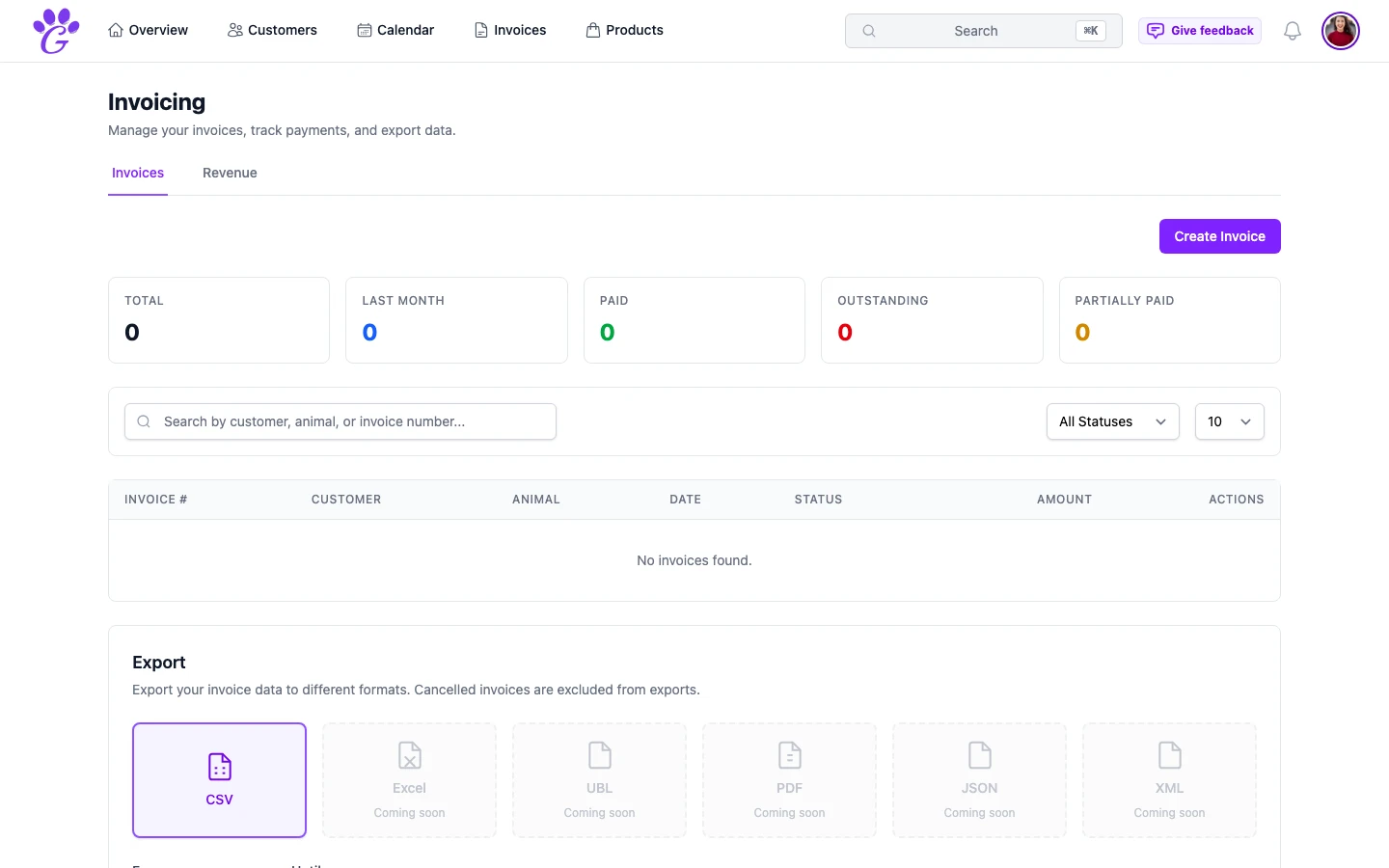
- Data export. Export your customers, pets, appointments, invoices and products to Excel or CSV at any time after your trial.
- Customer deletion. A client asks for "right to be forgotten"; you delete their customer record, including their pets.
- EU hosting. Customer data and its backups are stored in Microsoft Azure's West Europe region, in the Netherlands. The specialist providers we use, some of which process data outside the EU, are listed on the Where your data lives page.
- Per-user access. Role-based, so a receptionist doesn't need access to financial data.
Key capabilities
- Data export: Excel, CSV or a ZIP of CSV files with your customers, pets, appointments, invoices and products (notes and photos are not included).
- Deletion: delete individual customers yourself; your whole salon account is deleted when you ask: the request is reviewed, then carried out after 30 days.
- Processor agreement: a published Data Processing Agreement between you and GroomSome.
- Encrypted storage: data at rest and in transit.
How to set it up
An afternoon, once. Then a minor check yearly.
- Decide your retention period. How long do you keep records of inactive customers? A common choice is 3 years after last visit.
- Put a yearly clean-up in your calendar. GroomSome doesn't delete old records on its own, so you remove the ones past your retention period.
- Document what you collect. Your booking page, your customer record, your invoice: list what goes in, why, and how long. One page.
- Set up the privacy notice. A short notice, linked from your booking page, explaining what you collect and how clients can exercise their rights.
- Ask your team to turn on two-step sign-in (push approval in the GroomSome app, or a passkey). GDPR considers this a reasonable technical measure.
- Know the export flow. Test it once after your trial so you're not learning it under pressure.
If you're not sure about specifics, talk to your national data protection authority (Autoriteit Persoonsgegevens in NL, BfDI in DE, ICO in UK). They're surprisingly helpful to small businesses.
Responding to client requests
Clients have the right to request:
- Access: "Show me the data you hold about me." Respond within 30 days. GroomSome's export gets you most of the way; notes and photos aren't in it.
- Correction: "Update my address." Edit the record; done.
- Deletion: "Forget me." Delete the customer and their pets. Legal records like invoices may have to be kept for tax reasons.
- Portability: "Send me my data in a machine-readable format." CSV export.
- Restriction: "Stop using my data for X." Rarely triggered for a grooming salon, but possible.
Keep the responses friendly. Most requests aren't adversarial; they're usually a client with a normal question.
What not to do
A few traps worth avoiding:
- Don't email customer data in plain text. If a client asks for their record, send a password-protected PDF, or use a secure sharing service.
- Don't keep records "just in case" forever. Old records you can't justify are a liability, not an asset.
- Don't share data with other groomers or businesses without the customer's consent.
- Don't skip 2FA. It's the single most effective protection.
- Don't leave screens unlocked in public. Your phone, your laptop, your booking tablet; lock them all.
GDPR compliance isn't the most exciting part of running a grooming salon, but it's the part that protects both you and your clients when something does go wrong. Good software handles the hardest bits: encryption, export, deletion. What's left for you is mostly sensible habits and a short policy on your booking page. A small amount of setup now, and the "what if a client asks?" question becomes a two-minute answer instead of an afternoon of panic.